Showing posts with label rice. Show all posts

Saturday, September 24, 2011

Italy Part 25

That is the last [spaghetti] straw!!  This week marks the end of cooking pastas and risottos for my Italian cooking challenge. Noodle dishes have traditionally meant quick, last-minute meals requiring little more than a jar of store-bought tomato sauce. However, these dishes take basic pasta and rice to higher creative heights!

Penne alla napolitana (p. 109)
This dish can be made in under 40 minutes because the sauce can cook while the pasta cooks. It just takes a little bit of preparation of the wonderful vegetable medley that the sauce requires.  Ingredients include onion, garlic, carrot, celery, tomatoes (canned, crushed), and tomato paste. After tossing the hot pasta with the sauce, stir in a bit of freshly torn basil leaves and then sprinkle with parmesan. Simple and satisfying! 

The penne is hiding behind a handful of shredded parmesan.

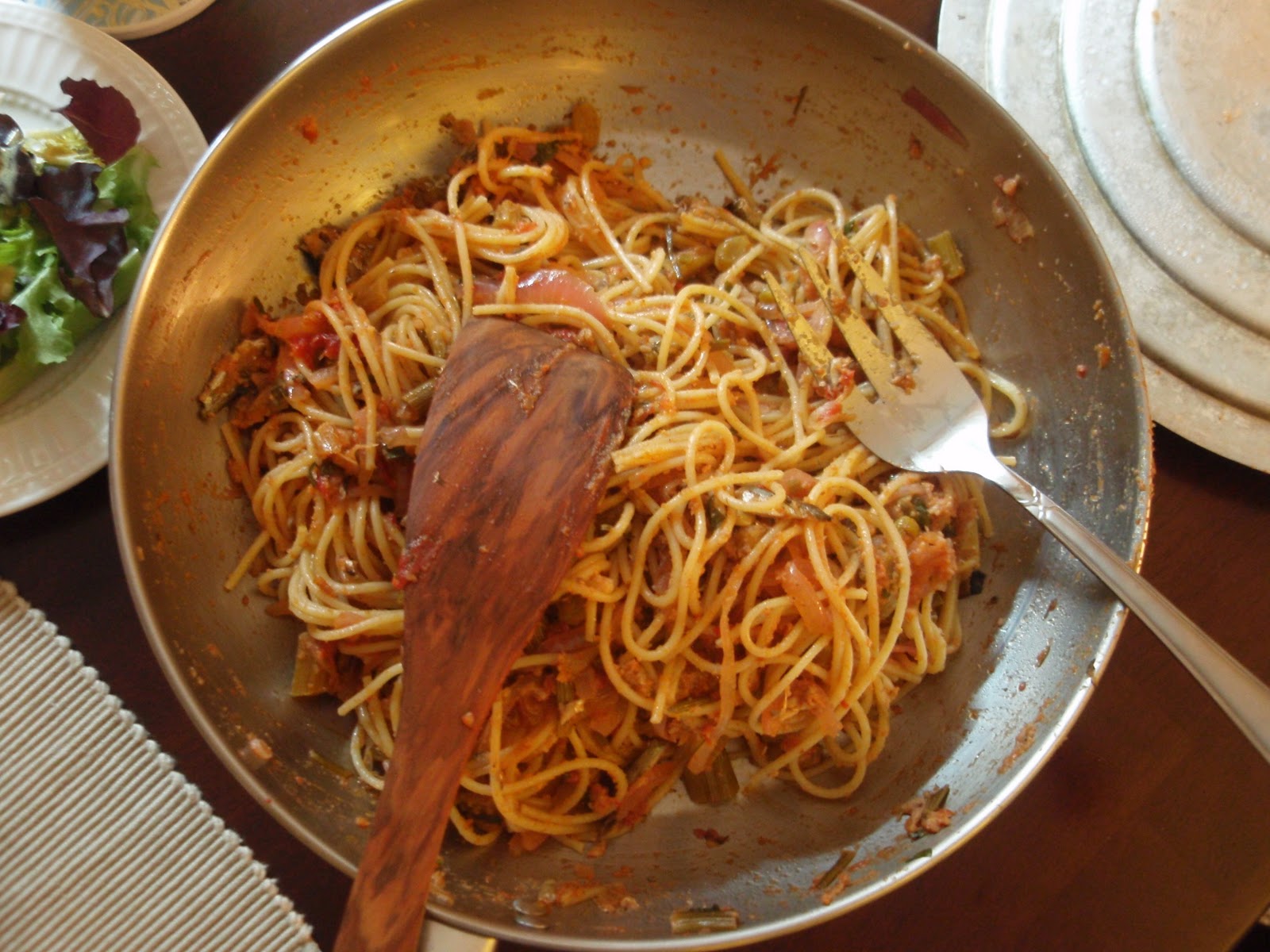
Spaghetti with sardines, fennel and tomato (p. 111)
This dish was one of those things that I should not have saved until the last moment... fennel is now out of season and I couldn't find it at my grocery stores!  Thank goodness I had saved some fennel stalks, which I had chopped up and kept in my freezer for a future creative experiment (I was thinking of using it as chicken stuffing along with some orange slices). Because of its extra fibrous nature, as compared to the fennel bulb, I steamed them for about 20 minutes using the hot water for the pasta before cooking further in the sauce as the recipe directed. Another problem ingredient was finding sardine fillets. I had stumbled across this same problem when preparing Stuffed sardines last month, and resorted to the next best thing... canned. The ingredient list for this dish is so eclectic! But the savory and sweet flavors blended very nicely. I would recommend trying the olive oil bread crumbs that this recipe asked for as a topping on your favorite pasta dish, too!

The sardines that I used to replace fresh fillets.
They are smaller and more delicate but since they are going
into a sauce, I thought they were an adequate substitute.
The sauce with all of its components:
garlic, fennel (stalks in this case), red onions,  raisins,
toasted pine nuts, anchovy fillets, white wine, tomato
pasta, fresh parsley, sardine and some bread
crumbs sauteed in olive olive. 
Despite the laundry list for ingredients, the finished product
was beautiful! Individual servings were topped with sprinkling
of some reserved olive oil bread crumbs and fresh parsley.

Seafood risotto (p. 116)
Gorgeous, gorgeous, gorgeous dish! I equate this savory Italian rice dish to a quick version of Spanish paella. Seafood ingredients included squid hoods and tentacles (reserved and frozen from my first squid recipe), raw shrimp, clams and fresh scallops. While the seafood was being gently sauteed in butter and olive oil, fish stock (reserved from preparing the Insalata di frutti di mare recipe) was simmering with white wine and saffron threads. After the seafood was cooked, it was removed from the frying pan and chopped onions and garlic were cooked until golden. Then, special arborio rice (recommended for risottos) was stirred into the cooked onions and garlic. Little by little, the hot broth mixture was added to the rice. This step is what makes risottos so unique! The result is a tender, but not mushy, creamy rice. The last steps included mixing the seafood, chopped tomatoes and parsley into the piping hot rice to get this...

Risotto for a special Friday night meal!
Note: Risotto is like a blank canvas for cooks.
Anything can be added to the rice, such as asparagus
and sun-dried tomatoes, left over seafood and peas,
various cheeses with mushrooms... etc, etc. 

Wednesday, August 3, 2011

Italy Part 14

Feast for Your Eyes: A week in Italy


Nothing like hot weather to make this girl slow down in the afternoons and spend time in the cool kitchen preparing some refreshing Italian meals while sipping chilled pinot grigio. The following is a visual tour of are some of the foods I prepared...


Meal #1
Carciofi all romana (p. 127)
Pork chops in marsala (p. 126)
Bread and salad


These stuffed artichokes are ready for the oven
after a few splashes of white wine. 
While the artichokes were cooking, it was time to prepare the chops.
I had never tasted marsala before- delicious with citrus! 
The pork chops and artichokes were ready to be dished up
with a side of feta-tossed salad, focaccia, and white wine.

Meal #2
Fennel fritters (p. 124)
Spaghetti with garlic and chili (p. 110)
Sicilian rice fritters (p. 144)


Fried crispy in a flour, egg, and bread crumb coating.
I only used one fresh chili but two would bring some serious heat.  
A nice blend of textures and flavor.
An ice cold mojito helped to finish off some fresh mint that
was left over from the artichoke stuffing used a few days before. 
While the oil was hot from the fennel fritters,
why not throw these in for a grease bath too?
Topped with warm honey and laced with lemon and fresh vanilla bean.

Meal #3
Mozzarella in carozza (p. 89)
Marjoram salmoriglio sauce (p. 132)
Shrimp and roasted zucchini


These "mozzarella in carriages," are a savory cousin to grilled cheese.
The sourdough bread was dipped in milk, then fresh mozzarella
was sandwiched within it, dipped in seasoned eggs and then breadcrumbs
and deep fried until crispy on the outside and gooey on the inside.
Fresh lemon brings balance.
These fried sandwiches where paired with fresh,
oven-roasted zucchini from the Farmer's Market
brushed with olive oil and sea salt, as well as
pan-seared shrimp with Marjoram sauce.   
I am looking forward to trying these sandwiches again using
stronger cheeses. Perhaps a provolone-blue cheese combo?


Meal #4
Baked eggplant with tomato and mozzarella (p. 102)
Espresso granitas (p. 147)
Pasta salad


The marvelous purple squishy vegetable!
This one has been scored to help soak up the awaiting hot oil.
They underwent an initial hot oil bath to soften its flesh.
Then, its insides were scooped out and combined with tomatoes, parsley,
oregano, and fried garlic and onions for a second cooking step with more hot oil.
Finally, the empty shells were piled high with the flavorful insides, topped
with mozzarella and placed into the oven for a third and final cooking step. 
Appetizing aubergine.
Not pictured: Espresso granitas.
They were eaten before I remembered to snap a photo! I will say that
making granitas is an excellent way to make use of extra coffee. 

Forty-one recipes completed. Forty-one recipes still yet to be made... the halfway point of my journey through Italy has been reached. 

Wednesday, July 13, 2011

Italy Part 7

Let's face it. Cooking my way through Italy has provided a food surplus in the Lazar apartment. In fact, last week I decided to slow this journey down a bit because we had too many leftovers for our modest refrigerator to handle; for example, you'd have to fumble around for 5 minutes just to find the cream cheese, and then, where are the bagels hiding? Not to mention, I am worried about the health of our refrigerator at the moment. Our milk has started souring early, our beers are not frosty, and my thermometer, which I placed on the top shelf, displays a needle that hovers around 50 (it should be below 41 degrees thank you)! This is a bit discerning for me - a gal who loves leftovers. For example, I think I've been eating that Chicken cacciatora (from last Friday) daily since Joe's work schedule keeps him from home for most of the day and then sends him home with a meal from the hospital cafeteria. Leftovers provide for a glamorous meal after pressing a few buttons on the microwave. 

I was reminded of my love for leftovers last night when Joe and I returned mid-afternoon from Summit Valley after completing our first "14er." Actually, we did two, climbing to the top of Gray's Peak first followed by Torrey's Peak since they stand a little less than a mile apart from each other. If you have not heard of a fourteener (you are probably not from Colorado... ah hem, as we were totally foreign to the concept), it is a mountaineering term used to describe a mountain that exceeds 14,000 feet above sea level. Long story short, you get really hungry after a climbing around the Rockies! We refueled at the top of Torrey's before the descent. With a view like that, I'll never forget that peanut butter sandwich. Then, we stopped for coffee in Georgetown, an old mining mountain town off of I-70, to regain our strength and reflect on the morning (it was only noon since we started up the mountain a little past 6:00 AM).  I had my best intentions to whip up some Pizza rustica dinner, but I didn't have the energy. As Joe passed out into a peaceful slumber, I heated up a magnificent meal from my supply of leftovers! This included the cacciatora (hehe) with a hardy side of Mushroom risotto.

Torrey's Peak, the second of summit of the morning.
Mushroom riscotto (p. 117)
This is probably one of my new Italian favorites. I made it as simple weekday meal and was surprised as how short the cooking time was. The only downside is that you have a lot of dishes to clean up, as it requires three stove tops to be cooking various components of the dish at the same time: the broth requires simmering with the steeped mushroom water (prepared from hydrating dried porini mushrooms), the mushrooms need to be sautéed with garlic, vermouth and a butter-olive oil combination, and lastly the rice and onions need constant stirring over heat while gradually folding in the mushrooms and broth. The final result is a creamy rice mush, but the rice is slightly chewy. Al dente I would say! The final step requires stirring in another pat of butter and a few handfuls of grated parmesan cheese. Plop a few scoops onto a plate and serve while its still steaming. The interesting part of risotto, from what I read, is that although it is served piping hot, Italians actually prefer to eat theirs after it has cooled a bit. To speed this process, it is commonly spread to the edges of the plate and then consumed from the edges to the center. I guess it allows the flavors to develop more. Also, did you know that you acquire the strongest flavors of a food or beverage at room temperature?  This risotto is really worth a short wait for maximum flavor extraction.

The hot, creamy Mushroom risotto straight from the stove.
Garnish with fresh oregano if you wish, but don't dive in yet! 
Eat like an Italian and play with your risotto before eating.
Here, I spread my risotto to the edges of the plate to increase
the surface area, speeding the cooling process.
And as I noted above, this dish makes excellent leftovers!

Sunday, July 10, 2011

Italy Part 6

Denver's weather pattern has shifted from being consistently scorching hot to having repetitive popcorn thunder bursts in the afternoon and evenings. These storms, with their cool wind gusts and thunder and rain percussion, arouse my desire to cook. Last Friday, this is exactly what happened and I opened to the Italian section of my cookbook.  I decided on a dinner of:

Arancini (p. 90)
Chicken cacciatora (p. 122)
Shaved fennel salad (p. 98)

Fresh fennel, often mislabeled as "anise" in supermarkets
(like King Soopers on Friday morning)! I chose female bulbs, which
have smaller, thinner bulbs compared to males.  Taking the time to
select for fennel gender s is worth it because females contain a more
potent flavor profile.  This salad only uses the bulbs, but I saved the
top leaves for future recipes (very fragrant herb).  Did you know that
fennel is a main ingredient in absinthe and it is
speculated to have many medicinal benefits?   
Let's eat!! Cacciatora translates to "hunter's choice"
and the recipe varies by region.  Generally, this dish calls for
tomatoes, onions, and chicken. This particular recipe called for
pancetta, mushrooms, and dry vermouth too. I browned
the chicken in oil first, then simmered it until the meat fell
off the bones. So delicious! I just wish I had a big casserole
dish that the recipe called for.  I tried using my biggest frying
pan and it was just barely containing its contents  (it was so full,
the lid rested on the chicken)! Served with white rice.
Yes, rice is used in much of Italy.
A closer look at the Arancini (stuffed rice balls).
For this recipe, I was forced to buy saffron... ugh,
it is just so darn expensive! But I had to follow my rules, no
 cutting corners.  Tasting just one of these rice balls
made me glad I bit the bullet. The rice was cooked with the
saffron, making it a bright yellow, sticky mess. The rice
was then combined with parmesan and eggs, stuffed
with fried minced beef, onions, oregano, and wine.
Once the balls were formed, they were rolled in white flour,
dipped in more egg and then coated in bread crumbs.
After brief refrigeration, they were dropped into a
hot pan of oil for 3 minutes until golden brown.

The stuffed rice balls required frying in oil, and I think this is a good chance to make a note about choosing oils for frying. Every oil is not the same. For Italian cooking, they use primarily olive oils, and if you ever stand in the baking isle of the grocery store to pick out an olive oil you have probably noticed the spectrum of types to choose from. There is "extra virgin" to "extra light". What does this really mean? It has a lot to do with processing, as well as ripeness (acid content) of the olives. Extra virgin olive oil is the least processed, meaning that the olives are pressed once without chemicals or heat. This is the highest quality, and most expensive, type of olive oil to purchase because it requires more olive input (usually less ripe ones); however it embodies an intense, fruity and almost buttery flavor. Extra light olive oil is composed of a filtered combination of refined olive oil with small amounts of virgin olive oil added back. The "light" descriptor doesn't come from having less calories, but instead it describes the pale color of the oil relative its dark green extra virgin cousin. The two other types in between these two extremes include, "virgin" that is pressed similarly to extra virgin but has a higher acidity from riper olives, and regular olive oil that has an even higher acidy with a bit of refined oil added back. 

Why bother with extra processing of olive oil? For culinary purposes of course!  I tend to choose my olive oils at the two extremes: Extra virgin, for garnishing foods after they are prepared or for low-heat cooking, and light olive oil for frying and high-heat cooking. The higher processing of the light olive oils allows for a higher smoke point. For example, for the rice balls, I needed to heat the oil to about 350 degrees (this was off the scale of my Martha Stewert thermometer, ha!) and extra virgin would have started stinking from oxidation long before reaching that temperature. Also, it is best to store your olive oils in a dark, cool place (like your pantry) to guard the oils from heat and light exposure, which can accelerate the transition to rancidity. Other oils, such as vegetable oils, have a unique story too, but that will have to save for future entry.