Showing posts with label pasta. Show all posts

Monday, November 7, 2011

Pumpkin Penne

In anticipation of Halloween, I couldn't help but bring home two large pumpkins with high hopes of making jack-o-lanterns.  Can anyone explain to me this mysterious seasonal craving to stick an arm into slimy insides of pumpkins?  As it turns out, I took my fill grabbing at knotted pumpkin seeds and pulp, however, no carving took place (I had forgotten that I live in an apartment complex without space to display such things without stinking up our living space... *sigh*).  Instead, I turned my pumpkins into something edible.  Surprised?  


One of many jars full of fresh pumpkin puree.  
Not pictured: Ziplocks full of roasted cubes for stews and curries (stay tuned). 


And who doesn't love an excuse to rev up their food processor? It is a simple joy of mine... and I learned that digesting roasted pumpkin flesh swill sure make those powerful little engines sing!  Due to the mass quantities of pumpkin I now have bottled and frozen, this orange squash has, and will continue to be, a fun ingredient to incorporate into novel fall-inspired meals. The first that I want to share with you is what I call, Pumpkin Penne (recipe below).  This is a perfect recipe for timid-squash eaters out there; the savory notes of spicy sausage and melted strong cheese will overpower the mild flavors of pumpkin, leaving a smile on any tasters face. Guaranteed.

Brown some spicy sausage in a spoon full of oil.
Remove the meat and cook onions and garlic until soft.
Add chicken broth, sage and bay leaves.
In the meantime, boil your penne al dente.
Add more broth, pumpkin puree, and cooked
sausage back into the pan to simmer. 
Stir in evaporated milk, cinnamon and nutmeg.
Season with salt and pepper to taste.
Once the sauce thickens, pour over the cooked penne
and mix well. Consume while hot!
Don't forget to top with grated parmesan or Romano.
Fresh sage or parsley make nice garnishes as well.
Try not to eat with your mouth full :)

Pumpkin Penne
Adopted from "Simply in Season" cookbook
Serves 8

1 pound penne pasta
1 pound bulk Italian sausage (I prefer spicy)
1 medium onion, finely chopped
4 cloves garlic, minced
1 bay leaf
2 Tbsp. fresh sage (julienned)
2 cups chicken broth, divided
1 cup pumpkin, cooked and pureed
1/2 cup (1 small tin can) evaporated milk
1/4 teaspoon cinnamon
1/2 teaspoon nutmeg
Salt and pepper to taste

Cook pasta, drain and set aside.  In a large lightly greased frying pan, cook sausage until browned, then remove from heat and set aside. Drain pan if needed. Add onion and garlic to the hot pan and cook until softened, about 5 minutes. Add bay and sage leaves, as well as 1 cup broth. Cook for about 2 minutes on medium-high heat or until half of the liquid evaporates. Mix in the remaining broth and pumpkin.  Cook, stirring, until mixture starts to bubble. Add back the sausage and reduce heat to a simmer.  Stir in milk and remaining seasonings and simmer 10 minutes to thicken. Remove bay leaf and pour the hot sauce over the penne. Toss or mix well. Serve with grated cheese (Romano or parmesan recommended) and additional sage or fresh parsley (optional).

Saturday, September 24, 2011

Italy Part 25

That is the last [spaghetti] straw!!  This week marks the end of cooking pastas and risottos for my Italian cooking challenge. Noodle dishes have traditionally meant quick, last-minute meals requiring little more than a jar of store-bought tomato sauce. However, these dishes take basic pasta and rice to higher creative heights!

Penne alla napolitana (p. 109)
This dish can be made in under 40 minutes because the sauce can cook while the pasta cooks. It just takes a little bit of preparation of the wonderful vegetable medley that the sauce requires.  Ingredients include onion, garlic, carrot, celery, tomatoes (canned, crushed), and tomato paste. After tossing the hot pasta with the sauce, stir in a bit of freshly torn basil leaves and then sprinkle with parmesan. Simple and satisfying! 

The penne is hiding behind a handful of shredded parmesan.

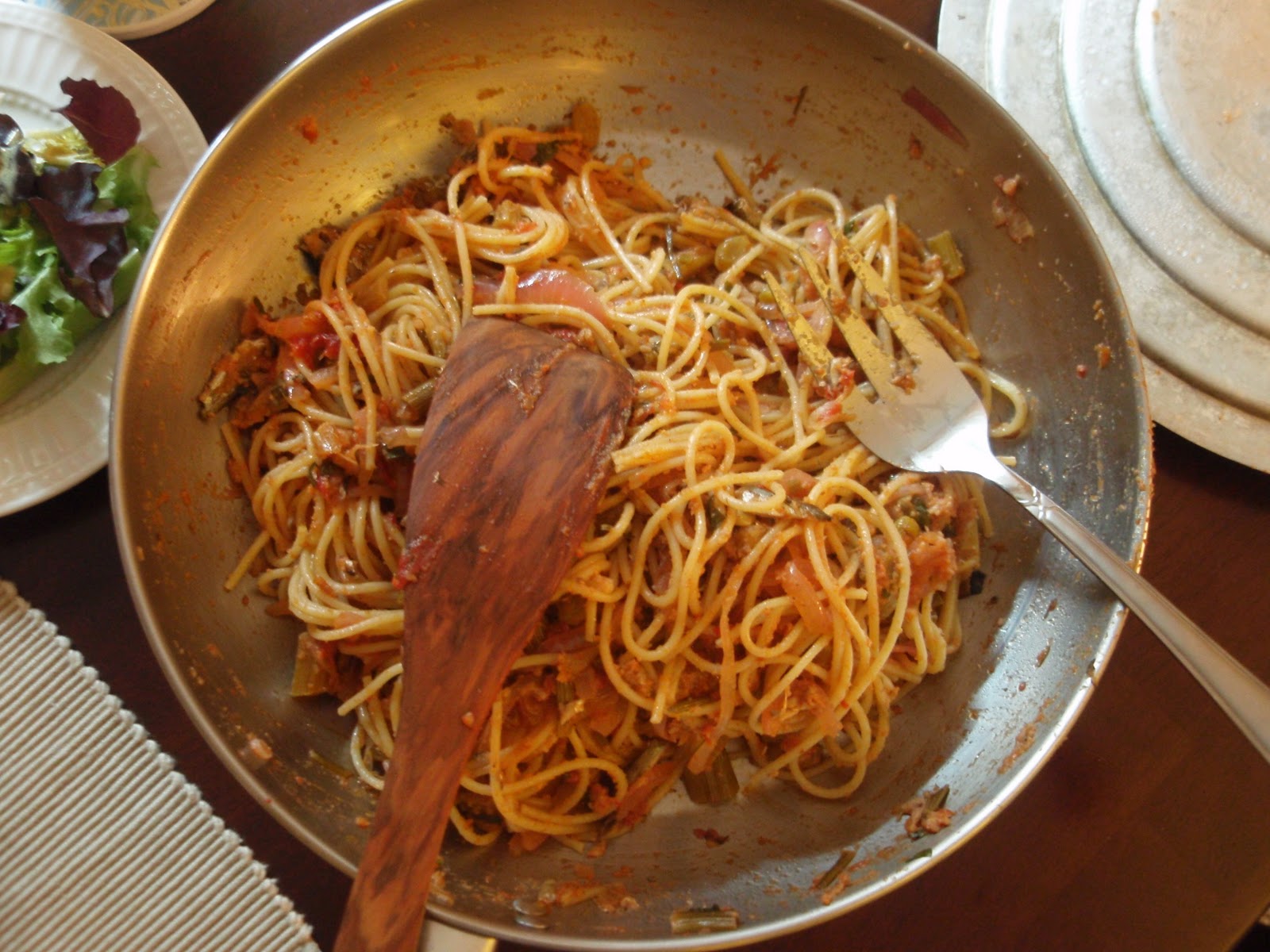
Spaghetti with sardines, fennel and tomato (p. 111)
This dish was one of those things that I should not have saved until the last moment... fennel is now out of season and I couldn't find it at my grocery stores!  Thank goodness I had saved some fennel stalks, which I had chopped up and kept in my freezer for a future creative experiment (I was thinking of using it as chicken stuffing along with some orange slices). Because of its extra fibrous nature, as compared to the fennel bulb, I steamed them for about 20 minutes using the hot water for the pasta before cooking further in the sauce as the recipe directed. Another problem ingredient was finding sardine fillets. I had stumbled across this same problem when preparing Stuffed sardines last month, and resorted to the next best thing... canned. The ingredient list for this dish is so eclectic! But the savory and sweet flavors blended very nicely. I would recommend trying the olive oil bread crumbs that this recipe asked for as a topping on your favorite pasta dish, too!

The sardines that I used to replace fresh fillets.
They are smaller and more delicate but since they are going
into a sauce, I thought they were an adequate substitute.
The sauce with all of its components:
garlic, fennel (stalks in this case), red onions,  raisins,
toasted pine nuts, anchovy fillets, white wine, tomato
pasta, fresh parsley, sardine and some bread
crumbs sauteed in olive olive. 
Despite the laundry list for ingredients, the finished product
was beautiful! Individual servings were topped with sprinkling
of some reserved olive oil bread crumbs and fresh parsley.

Seafood risotto (p. 116)
Gorgeous, gorgeous, gorgeous dish! I equate this savory Italian rice dish to a quick version of Spanish paella. Seafood ingredients included squid hoods and tentacles (reserved and frozen from my first squid recipe), raw shrimp, clams and fresh scallops. While the seafood was being gently sauteed in butter and olive oil, fish stock (reserved from preparing the Insalata di frutti di mare recipe) was simmering with white wine and saffron threads. After the seafood was cooked, it was removed from the frying pan and chopped onions and garlic were cooked until golden. Then, special arborio rice (recommended for risottos) was stirred into the cooked onions and garlic. Little by little, the hot broth mixture was added to the rice. This step is what makes risottos so unique! The result is a tender, but not mushy, creamy rice. The last steps included mixing the seafood, chopped tomatoes and parsley into the piping hot rice to get this...

Risotto for a special Friday night meal!
Note: Risotto is like a blank canvas for cooks.
Anything can be added to the rice, such as asparagus
and sun-dried tomatoes, left over seafood and peas,
various cheeses with mushrooms... etc, etc. 

Tuesday, September 6, 2011

Italy Part 16

Seems like ages ago when I was sitting in a dark, cold movie theater watching the new drama, Julie & Julia, when suddenly everything when black. The big screen was blank and the lights that normally illuminate the exit halls were out. I couldn't even see my toes, which were a few feet in front of my face, propped up on an empty seat. The crowd began to shift with curiosity, whispering and then questioning, unabashed,  What happened to the movie?! Will we get a refund? Where are the lights?! Is there a bomb in the mall?! Are we going to die?!  Ok, perhaps our frustrations were a little exaggerated, but the movie plot was nearing the climax and I think we were all a little peeved when the theater staff eventually made everyone exit through dark hallways due to "electrical issues." I never got to see what happened to the aspiring blogger, "Julie," who was cooking 524 recipes in 365 days from Julia Child's cookbook, Mastering the Art of French Cooking.  That was, until, the movie arrived in my  mailbox earlier this week and I got to watch the entire feature, start to finish! I made Joe watch with me, promising him that the movie, "will explain a lot" about my current obsession with cooking and blogging. Looking back, I am actually thankful that the power went out that day at the theater because I was able to now watch it at a time in my life when I feel more aligned with the movie characters. How silly I must sound! 

It goes without saying that the movie definitely stirred up new motivation to finish my culinary challenge to cook my way through the Italian section of my Essential Mediterranean Cookbook (refer to Italy Part 1).  So here I am, the half-way point being reached nearly one month ago with 41 recipes completed and 41 to go (Italy Part 14), and since then I have only completed five more recipes?! If "Julie" can complete 524 advanced French recipes in 365 days, I can surely complete 36 Italian recipes in the next two months. This means that I have officially made a deadline: October 31st. Halloween

Let's get on track with an easy, seasonal pasta recipe: Orecchiette with broccoli (p. 108). 

Orecchiette is a pasta that resembles "little ears."
As my luck would have it, I couldn't find it at my local
grocery stores, so I substituted with a medium shell. 
Perhaps my favorite kitchen accessory:
 Calphalon multi-purpose stainless steel pot.
For this recipe, I could blanch broccoli, drain it, and
then return the strainer to the hot water to cook
the pasta without skipping a beat.
A simple pasta dinner. Just add chilled rose!
The blanched broccoli was sauteed in hot olive oil with chili flakes, garlic and anchovies. After a good toss with freshly grated parmesan, additional olive oil and salt, it is ready for sharing. This pasta was so refreshing and can easily stand alone as a single-dish meal.  More to come soon! 


Note to readers: If you desire a recipe for any of these Italian dishes, feel free to contact me. Due to copyright issues, I do not post recipes from the book on my blog pages. 

Wednesday, August 3, 2011

Italy Part 14

Feast for Your Eyes: A week in Italy


Nothing like hot weather to make this girl slow down in the afternoons and spend time in the cool kitchen preparing some refreshing Italian meals while sipping chilled pinot grigio. The following is a visual tour of are some of the foods I prepared...


Meal #1
Carciofi all romana (p. 127)
Pork chops in marsala (p. 126)
Bread and salad


These stuffed artichokes are ready for the oven
after a few splashes of white wine. 
While the artichokes were cooking, it was time to prepare the chops.
I had never tasted marsala before- delicious with citrus! 
The pork chops and artichokes were ready to be dished up
with a side of feta-tossed salad, focaccia, and white wine.

Meal #2
Fennel fritters (p. 124)
Spaghetti with garlic and chili (p. 110)
Sicilian rice fritters (p. 144)


Fried crispy in a flour, egg, and bread crumb coating.
I only used one fresh chili but two would bring some serious heat.  
A nice blend of textures and flavor.
An ice cold mojito helped to finish off some fresh mint that
was left over from the artichoke stuffing used a few days before. 
While the oil was hot from the fennel fritters,
why not throw these in for a grease bath too?
Topped with warm honey and laced with lemon and fresh vanilla bean.

Meal #3
Mozzarella in carozza (p. 89)
Marjoram salmoriglio sauce (p. 132)
Shrimp and roasted zucchini


These "mozzarella in carriages," are a savory cousin to grilled cheese.
The sourdough bread was dipped in milk, then fresh mozzarella
was sandwiched within it, dipped in seasoned eggs and then breadcrumbs
and deep fried until crispy on the outside and gooey on the inside.
Fresh lemon brings balance.
These fried sandwiches where paired with fresh,
oven-roasted zucchini from the Farmer's Market
brushed with olive oil and sea salt, as well as
pan-seared shrimp with Marjoram sauce  
I am looking forward to trying these sandwiches again using
stronger cheeses. Perhaps a provolone-blue cheese combo?


Meal #4
Baked eggplant with tomato and mozzarella (p. 102)
Espresso granitas (p. 147)
Pasta salad


The marvelous purple squishy vegetable!
This one has been scored to help soak up the awaiting hot oil.
They underwent an initial hot oil bath to soften its flesh.
Then, its insides were scooped out and combined with tomatoes, parsley,
oregano, and fried garlic and onions for a second cooking step with more hot oil.
Finally, the empty shells were piled high with the flavorful insides, topped
with mozzarella and placed into the oven for a third and final cooking step. 
Appetizing aubergine.
Not pictured: Espresso granitas.
They were eaten before I remembered to snap a photo! I will say that
making granitas is an excellent way to make use of extra coffee. 

Forty-one recipes completed. Forty-one recipes still yet to be made... the halfway point of my journey through Italy has been reached. 

Friday, July 22, 2011

Italy Part 9

Oodles of Noodles: A pasta preview from campanelle to bucatini

Next to pizza, I would guess that Italians are well associated with pasta. What a laundry list of pasta-based dishes that come to mind! There is spaghetti with meatballs, lasagna, ravioli, da da da.  In short, the Italians have mastered the combination of shells and sauce. Perhaps, in an effort to chase away mundane meals, they have created a myriad varietal shapes for their beloved staple food. For example, there is the iconic spaghetti noodle that is long, round and thin, which differs from linguini that is long and thin, but also flat, which differs from bucatini that is long but thicker and hollow, which is different from the beloved round, small hollow tube macaroni noodle. 

Use this link, posted by the National Pasta Association, which describes and illustrates a fairly comprehensive list of pasta shapes (which is very useful for hunting down a new pasta to try, or for visualizing one mentioned in a new recipe, before gawking at the grocery store noodle isle):  http://www.ilovepasta.org/shapes.html

Besides all of these crazy noodle shapes, there are actually only two categories of pasta: "wet" and "dry". They are both wheat based, however, the difference is that wet pasta uses a softer type of wheat flour and contains eggs, whereas dry pasta uses hard durum wheat semolina.  How to choose which type to use for your recipe? In general, wet pasta is preferred for lasagna and stuffed pasta dishes; the "wet" quality allows for a dough that can be molded as needed for the stuffing. You can find these in the refrigerated section of the grocery store, or venture to make it yourself!  By contrast, dry pasta is more versatile and provides for the "al dente" texture after boiling. I almost prefer dry pasta solely based by its long shelf life and quick prep time.  

The following is a preview of some pasta dishes I have prepared recently. Cheers to noodles! 

Bucatini amatriciana (p. 109)
Before I had done research on pasta, I went to the grocery store and searched the pasta isle, 

head to toe, for "bucatini." No bingo.  I substituted linguini for this recipe knowing that dry pasta 
is composed of the same basic ingredients, just different shapes. 
Looking back, I wasn't too far off with my substitution, considering the long noodle shape!
Linguine pesto (p. 108)
This recipe was whipped up in no time since I had pre-made the pesto.
Just take the pesto out of the freezer and into the fridge the night before and stir into hot pasta.
Try shaving your parmesan with a veggie peeler for a sophisticated garnish (this photo shows grated). 
Bucatini alla norma (p. 113)
Perhaps my favorite pasta shape! This is true bucatini thanks to Super Target carrying the only bucatini in town.
The noodles resemble tiny straws with a consistency that is thick and chewy.
This recipe called for eggplant, yippee! Many would disagree, but I absolutely adore this mushy, purple vegetable. 
Using my thinking noodle to create my own pasta dish!
I was craving a cold pasta salad, an American summer tradition.
For this recipe I used "campenelle" pasta, which means "small bells".
This recipe allowed me to make use of leftover sun-dried tomatoes and asparagus
(blanching the asparagus in the boiling water that was heated for the pasta),
all tossed in an olive oil, mustard, white wine, and parsley and lemon vinaigrette.


Trivia for your thinking noodle:
Marco Polo, as popular legend has it, was the one to introduce pasta to Italy in the 13th century after visiting the Far East. However, its origin dates back to ancient Greek mythology, in which the Greek God, Vulcan, invented a device that made strings of dough... sounds like spaghetti. Even the Chinese were making a type of noodle since 3000 B.C.  For more information, visit here.